The consumer health market operates on a seductive premise: continuous, effortless insight into your inner workings. Slip on a piece of machined aluminum and glass, and your wrist becomes a reliable biometric portal. Among these metrics, wrist-based blood pressure (BP) tracking is marketed as a game-changer for hypertensive patients.
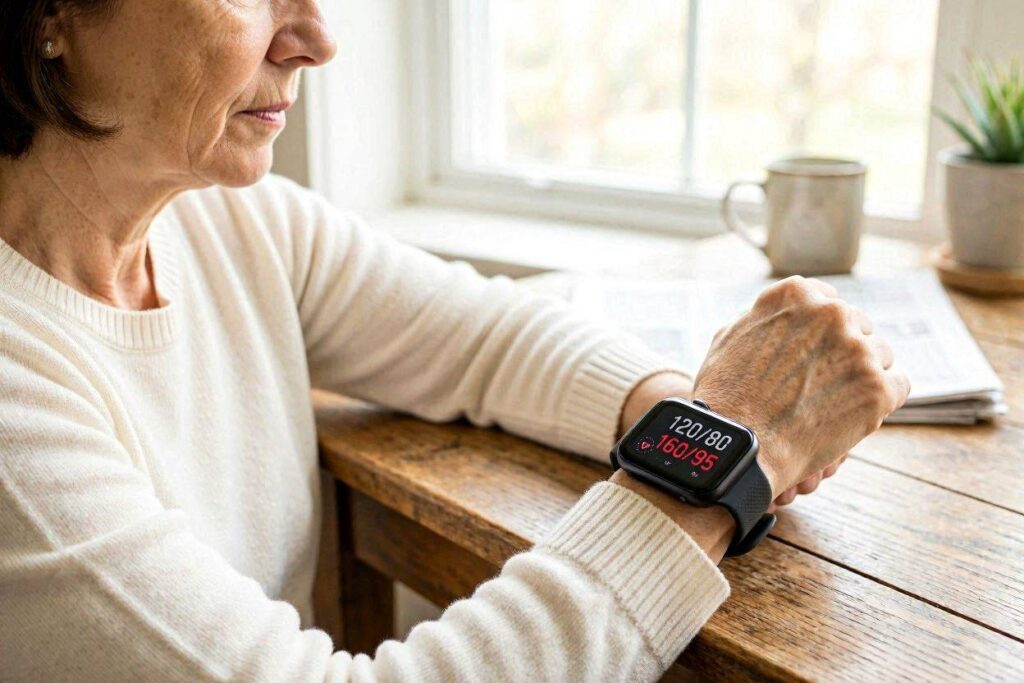
Yet, as millions of users swap traditional medical devices for sleek wristwear, a silent systemic crisis is emerging. The convenience of these devices masks an uncomfortable truth: smartwatch blood pressure readings are highly susceptible to significant errors.
Unlike established heart-rate tracking, tracking blood pressure from the wrist introduces complex physiological and computational challenges. Relying on these devices for medical-grade insights reveals serious accuracy gaps, engineering bottlenecks, and real-world health risks.
1. The Physics of the Flaw: Why Smartwatch Sensors Misread Pressure
To understand where errors originate, you must recognize that your smartwatch is completely blind to actual pressure. A doctor uses a physical cuff to compress an artery and measure the literal force of your blood. A smartwatch, however, utilizes photoplethysmography (PPG)—shining light into your skin to observe changes in blood volume.
[Optical Sensor Flashes Light] ──> [Measures Blood Volume Changes] ──> [Algorithm Guesses Pressure]
This indirect methodology creates multiple points of failure where major errors can occur.
The Problem with Peripheral Amplification
Blood pressure is not a static number that remains identical across your entire body. The pressure wave alters its shape and strength as it travels from the large brachial artery in your upper arm down to the tiny radial artery and superficial capillaries in your wrist.
Because the vessels in your wrist are smaller and highly responsive to ambient temperature, stress, and posture, the raw signal captured at your wrist often diverges significantly from your true central blood pressure. This inherent physiological difference creates a baseline error that algorithms struggle to correct.
Hydrostatic Pressure Mismatch
The weight of the fluid column in your blood vessels changes based on gravity. For an accurate reading, a blood pressure assessment must occur precisely at heart level.
- If your arm rests low on a desk during an automatic background reading, gravity pulls blood downward, artificially inflating the watch’s reading.
- If your hand is raised, the hydrostatic pressure drops, leading to an artificially low reading.
Because smartwatches try to capture data passively throughout the day, they frequently log inaccurate readings simply because the user’s arm was in motion or improperly positioned.
2. Emerging Challenges: The New Frontiers of Wearable Error
As wearable engineering tries to fix these initial issues, new and more complex technical challenges are surfacing.
1. Calibration Drift and Demographic Trapping
Most current blood pressure watches require initial calibration using a standard upper-arm cuff. The watch’s internal software takes your cuff reading and builds a custom mathematical scale for your wrist.
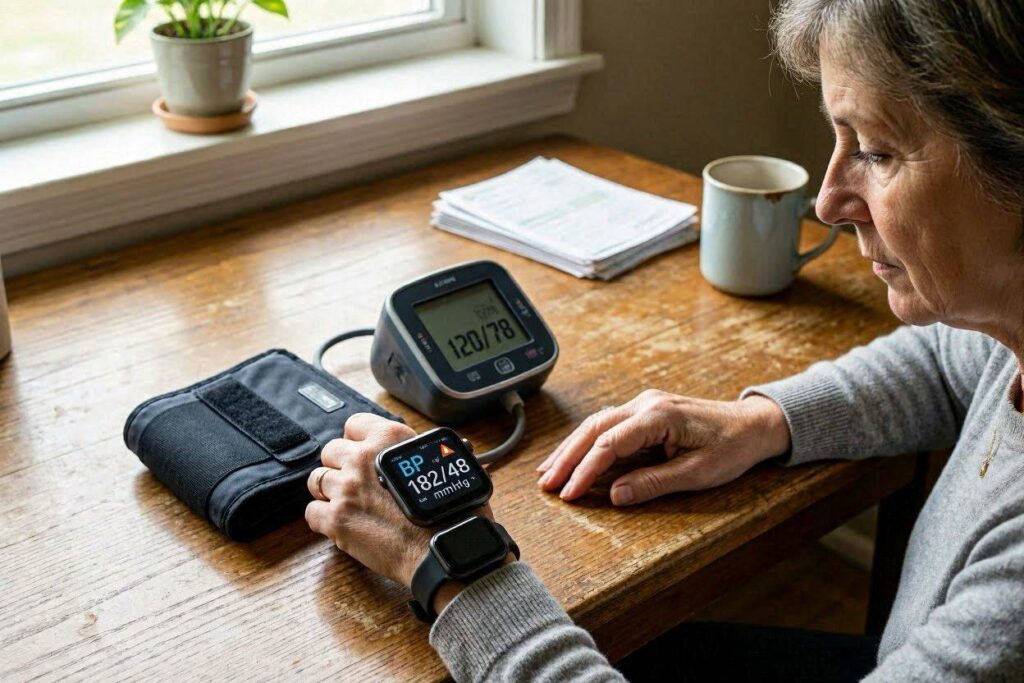
The problem? Your body is dynamic. Changes in hydration, caffeine intake, arterial stiffness, or a simple weight shift can cause the watch’s baseline calculations to drift within days.
When “calibration drift” happens, the watch continues to output readings based on old data, masking dangerous spikes or dips. Furthermore, many budget smartwatches rely on restrictive, pre-programmed demographic profiles. If your unique physiology falls outside their standard assumptions, the device will output inaccurate, generalized data.
2. Motion Artifact Destabilization
The human wrist is rarely completely still. Micro-movements from everyday actions like typing, gripping a steering wheel, or walking create massive waves of distortion in the optical sensor’s signal. These distortions are called motion artifacts.
When a watch encounters heavy motion artifacts, its software attempts to clean the data by filtering out the noise. However, this filtering process can accidentally erase critical parts of your actual pulse wave, forcing the algorithm to guess the missing information. This often results in a completely inaccurate blood pressure reading on your screen.
3. Skin Tone and Perfusion Inequity
A significant challenge facing optical health tech is the variance in human skin tones. Melanin absorbs green light—the wavelength most frequently used by consumer smartwatches to track blood flow.
Darker Skin Tones ──> Higher Green Light Absorption ──> Weaker Pulse Signal ──> Higher Algorithm Error Rate
In individuals with higher melanin levels, or those with poor peripheral circulation (cold hands), the sensor receives a weak, degraded signal. If the device tries to amplify this weak signal, it amplifies the background noise as well, increasing the likelihood of an incorrect reading.
3. The Psychological and Medical Consequences of False Data
The errors generated by smartwatches are not just minor technical bugs; they have real consequences for patient health and behavior.
The Illusion of Safety
For a hypertensive patient, a watch that consistently underreports blood pressure acts as a dangerous false security blanket. If a user’s true blood pressure is sitting at a dangerous 150/95 mmHg, but their uncalibrated smartwatch displays a comfortable 120/80 mmHg, the patient may neglect to take their medication or skip an important doctor’s visit. This turns a tracking error into a life-threatening blind spot.
The Anxiety Loop
Conversely, a watch that overestimates blood pressure due to motion artifacts can trigger intense health anxiety. When a user sees an unexpectedly high reading, their body reacts by releasing adrenaline and cortisol. This stress response physically drives up their actual blood pressure, creating a frustrating loop where a false reading leads to real-world hypertension.
4. Current Market Realities: Tracking Trends vs. Clinical Truth
Because true medical accuracy remains difficult to achieve at the wrist, the wearable market is currently split into two distinct categories:
| Device Classification | Core Technology | Primary Function | Medical Reliability |
| Consumer Smartwatches | Pure Optical PPG / Algorithm-Based | General wellness; identifying broad lifestyle trends over time. | Low to Moderate; prone to frequent individual reading errors. |
| Medical Wearables | Micro-Inflatable Wrist Bladders or Certified Sensors | Active monitoring and diagnostic support for hypertension. | High; undergoes rigorous independent clinical testing. |
Most mainstream electronics manufacturers protect themselves from liability by burying disclaimers in their user manuals, stating that their blood pressure features are not intended for medical diagnosis or clinical use. Unfortunately, consumers often overlook these warnings, treating a general lifestyle tracker as a certified medical tool.
5. The Path to Error Reduction
To transform the smartwatch from an unreliable trend tracker into a dependable medical device, the wearable industry must change its approach to sensor design and software development.
- Transitioning to Multi-Wavelength Sensors: Moving away from standard green light toward infrared light allows sensors to penetrate deeper into the skin tissue, reducing signal interference caused by skin tone variations.
- Integrating Bioimpedance Analysis: By combining optical sensors with bioimpedance tracking—which measures how tissue resists weak electrical currents—smartwatches can gather real-time data on arterial wall tension, relying less on rigid historical baselines.
- Smart Position Filtering: Future software must actively block readings unless internal motion sensors confirm the user has kept their arm completely still and level with their heart for a set period.
Until these advanced hybrid systems become common, the traditional upper-arm cuff remains the gold standard for accuracy. A smartwatch can serve as an interesting way to observe daily lifestyle trends, but any unexpected reading should always be checked with a verified medical monitor before making decisions about your health.