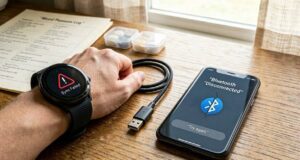
A blood pressure watch without calibration sounds like an ideal solution for people who want to monitor their blood pressure without using a traditional cuff. Put the watch on your wrist, take a reading, and check the result whenever you need it. It is simple, convenient, and fits easily into everyday life.
However, there is an important difference between convenience and accuracy. Not all blood pressure watches measure blood pressure in the same way, and the phrase “without calibration” can mean different things depending on the technology used by the manufacturer.
Before buying a watch for blood pressure monitoring, it is worth understanding how these devices work, what calibration means, and what you should look for when comparing different models.
What Is a Blood Pressure Watch Without Calibration?
A blood pressure watch without calibration is designed to provide blood pressure information without requiring the user to compare the watch with a traditional cuff-based blood pressure monitor during setup.
Traditional blood pressure monitors normally use an inflatable cuff placed around the upper arm. Many wearable devices, however, use sensors and software to estimate blood pressure from signals collected at the wrist.
The technology can vary considerably from one product to another. Some watches use optical sensors, while others may use additional sensors or specialized systems. Because of these differences, consumers should not assume that every watch advertised as a calibration-free blood pressure monitor works in exactly the same way.
This is one reason it is important to read the manufacturer’s specifications before purchasing blood pressure watches.
Why Do Some Blood Pressure Watches Need Calibration?
Calibration is used to improve the relationship between the signals detected by a wearable device and the blood pressure values it reports.
For example, a watch may ask the user to take readings with a conventional blood pressure cuff while wearing the smartwatch. The watch uses those reference measurements to establish a baseline. Depending on the device, this process may need to be repeated from time to time.
The idea behind calibration is relatively straightforward: the wearable device collects sensor information, while the cuff provides a reference measurement.
A watch that does not require this process may appear more convenient, but that does not automatically mean it is more accurate.
Are Blood Pressure Watches Without Calibration Accurate?
Accuracy is the biggest question for anyone searching for a blood pressure watch without calibration.
A smartwatch can be very convenient, but blood pressure is not as simple to measure as steps or heart rate. Blood pressure changes throughout the day and can be affected by movement, stress, posture, exercise, caffeine, and other factors.
The way a watch sits on the wrist can also affect sensor readings.
For this reason, it is important to look for independent validation or appropriate regulatory information rather than relying only on marketing claims. A company describing its product as “accurate” does not by itself prove that the device performs as well as a validated upper-arm blood pressure monitor.
How Do Calibration-Free Blood Pressure Watches Work?
Different manufacturers use different technologies, so there is no single method used by all calibration-free watches.
Many wearable devices rely on optical sensors. These sensors shine light into the skin and analyze changes in the reflected light associated with blood flow. Algorithms can then use this information to estimate blood pressure.
Other technologies may use additional sensors or different approaches to obtain information from the wrist.
The software is an important part of the process. The watch does not simply display a number directly from a sensor. Instead, sensor signals are processed by algorithms to produce an estimated blood pressure value.
This makes the quality of both the hardware and software important when comparing blood pressure watches.
What Should You Look for When Buying One?
If you are interested in a blood pressure watch without calibration, do not make your decision based on the word “calibration-free” alone.
Consider these factors before buying.
1. Measurement Technology
Find out how the watch estimates or measures blood pressure. A manufacturer should provide clear information rather than simply claiming that the watch can monitor blood pressure.
2. Validation Evidence
Look for information about clinical validation or other appropriate testing. Independent evidence can be much more useful than advertising language.
3. Regulatory Status
Check whether the blood pressure feature has the appropriate authorization or clearance for the market where you live. Regulatory status can vary by country and by specific product feature.
4. Ease of Use
A watch may have advanced technology, but it is not very useful if taking a measurement is complicated. Look for clear instructions and an easy-to-understand app.
5. Data History
A useful smartwatch should allow you to review previous readings. Being able to see measurements over time makes it easier to identify patterns.
6. Smartphone Compatibility
Check whether the watch is compatible with your smartphone. Some blood pressure watches are designed primarily for particular operating systems or phone brands.
7. Battery Life
Blood pressure monitoring is more useful when the watch can be worn consistently. Longer battery life can make regular tracking more convenient.
Can a Blood Pressure Watch Replace a Cuff?
This is an important question.
A calibration-free blood pressure smartwatch should not automatically be treated as a replacement for a validated upper-arm blood pressure monitor. For people who need accurate measurements for medical management, a conventional validated monitor may remain the preferred option.
A smartwatch can be useful for convenience and general tracking, depending on the device and its intended use.
If a watch produces an unexpected reading, it is sensible to confirm it using an appropriate blood pressure monitor rather than immediately assuming that the smartwatch reading is correct.
Benefits of a Blood Pressure Watch Without Calibration
There are several reasons people are interested in these devices.
The biggest advantage is convenience. You do not need to carry a separate cuff everywhere, and the watch can remain on your wrist during normal daily activities.
Another benefit is accessibility. Someone who wants to keep an eye on blood pressure trends may find it easier to take readings with a watch than to set up a traditional monitor several times a day.
Many blood pressure watches also provide other health features, such as heart-rate monitoring, activity tracking, sleep information, and notifications.
Having several functions in one wearable device can make health tracking much more convenient.
Limitations You Should Know About
The biggest limitation is that wearable blood pressure technology is still different from traditional cuff-based measurement.
Wrist position, movement, skin contact, temperature, and individual differences can influence sensor-based measurements. Some people may also find that readings vary between a smartwatch and a conventional monitor.
Another issue is that product descriptions can sometimes be confusing. A watch may advertise blood pressure-related features without clearly explaining whether it directly measures blood pressure or estimates it.
Always read the technical details carefully.
Who Might Benefit From These Watches?
A blood pressure watch without calibration may appeal to people who want convenient health tracking and prefer wearing a smartwatch instead of carrying a separate monitoring device.
It can also be useful for people interested in recording trends throughout the day, provided the particular device has an appropriate and reliable blood pressure feature.
However, people who have been instructed by a healthcare professional to monitor their blood pressure should follow that professional’s advice regarding the type of monitor and measurement method to use.
A blood pressure watch without calibration can sound like the perfect answer for convenient blood pressure monitoring. There is no need to perform repeated calibration, and the device can be worn throughout the day.
But convenience should not be the only consideration.
When comparing blood pressure watches, pay attention to measurement technology, validation evidence, regulatory information, ease of use, compatibility, and data tracking. Most importantly, understand whether the device actually measures blood pressure or provides an estimate based on sensor data.
For people who require dependable blood pressure measurements, a validated upper-arm monitor can remain an important tool. A smartwatch may provide an additional layer of convenience, but it should not be relied upon blindly for important health decisions.
The best approach is to choose a device based on evidence and the manufacturer’s documented capabilities rather than simply choosing the watch that makes the strongest “no calibration” claim.