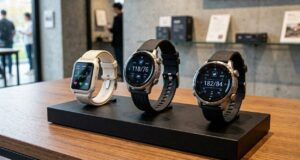
The consumer health landscape has entered a hyper-connected era where medical metrics are continuously displayed on our wrists. Among these features, non-invasive, cuffless blood pressure (BP) tracking on smartwatches stands out as highly appealing. For individuals managing hypertension, the prospect of tracking cardiovascular health without carrying a bulky upper-arm cuff is attractive.
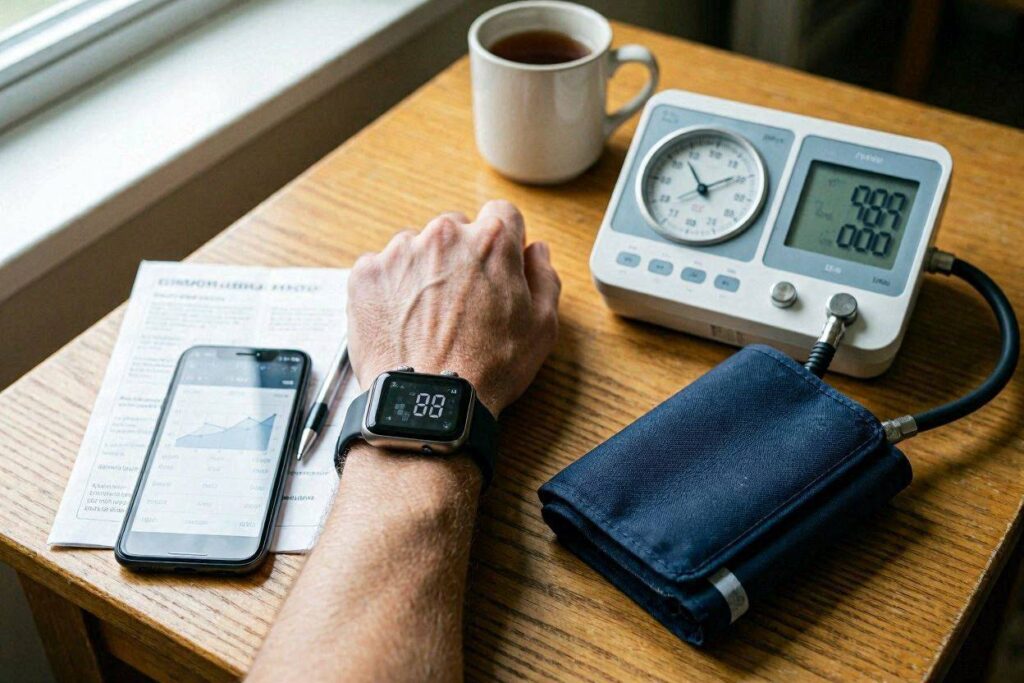
However, beneath the sleek user interfaces and sleek marketing campaigns lies a persistent reality: wrist-based blood pressure readings are highly susceptible to significant errors.
Unlike smartwatches tracking heart rate or steps, tracking blood pressure through the skin of the wrist introduces complex physiological and algorithmic challenges. For consumers navigating their health choices, understanding the mechanics behind these inaccuracies, the emerging issues in sensor design, and the clinical challenges of wearable tech is essential.
1. How Optical Metrics Fail to Measure Real Pressure
To understand why a blood pressure watch produces inaccurate readings, you must first recognize a fundamental technical reality: your smartwatch does not measure blood pressure; it guesses it.
A traditional doctor’s cuff uses a physical bladder to compress the brachial artery, measuring the literal mechanical force of blood pushing against that restriction. In contrast, standard consumer smartwatches rely on Photoplethysmography (PPG). Optical sensors shine green or infrared light into the superficial capillaries and radial vessels of the wrist, tracking changes in blood volume with every heartbeat.
[Traditional Cuff] ──> Measures literal mechanical arterial force (Oscillometric)
[Smartwatch Tech]   ──> Tracks light absorption changes in tiny vessels (PPG Inference)
The watch captures a pulse waveform, and a proprietary machine-learning algorithm converts this optical data into an estimated systolic and diastolic number. This means the device relies on a proxy measurement. If the optical wave is distorted by outside factors, the mathematical conversion fails, resulting in an inaccurate reading.
2. Core Biological Challenges to Wrist-Level Tracking
The human wrist is an imperfect location for tracking systemic blood pressure. Several biological barriers make precise data collection difficult for wearable sensors:
Hydrostatic Disconnect
Blood pressure changes significantly based on the vertical position of your limb relative to your heart. Traditional upper-arm cuffs sit naturally at heart level. A watch, however, moves constantly throughout the day.
- If a watch automatically triggers a reading while your hand is resting low by your side, gravity pulls blood into your forearm, falsely elevating the reading.
- If your arm is raised above your heart, the local pressure drops, outputting a falsely low reading.
Peripheral Wave Amplification
Blood pressure is not uniform across your circulatory system. As the pressure wave travels from the aorta through the large brachial artery down into the smaller, branching radial arteries of the wrist, its shape alters. This phenomenon, known as pulse wave amplification, changes based on age, vascular health, and stress levels. A reading taken at the wrist often differs significantly from a central arterial reading, creating a baseline error that software struggle to fix.
Motion Artifact Distortion
The wrist is a hub of constant motion. Daily actions like typing, holding a steering wheel, or lifting objects create micro-shifts in how the watch rests against your skin. These movements introduce “noise” into the optical sensor’s signal. When a watch encounters this noise, its software tries to clean the wave, which can accidentally erase important pulse data. The algorithm is then forced to guess the missing info, leading to a flawed reading.
3. Emerging Challenges: Algorithmic Bias and Tracking Faults
As engineers try to improve wearable technology, the industry is running into complex, newly recognized technical bottlenecks.
1. The Trap of Algorithmic Homogeneity
The software converting optical pulse waves into blood pressure readings relies on machine-learning models trained on historical databases. If an electronics manufacturer trains its algorithm primarily on a cohort of young, healthy individuals with elastic blood vessels, that algorithm will perform poorly when worn by an older individual with arterial stiffness. The watch attempts to force a unique, aging cardiovascular system into a standardized statistical box, leading to inaccurate tracking for high-risk demographics.
2. Calibration Drift Blind Spots
Most reputable blood pressure watches require users to calibrate the device once a month using a traditional upper-arm cuff. The watch uses this cuff data as an anchor for its mathematical scaling.
However, your vascular system changes dynamically based on hydration levels, caffeine consumption, and seasonal temperatures. Over a couple of weeks, the watch’s internal baseline encounters calibration drift. When this occurs, the device may continue to output comfortable, normal readings based on old data, failing to alert a patient to a genuine, dangerous spike in blood pressure.
3. Melanin Absorption Inequity
A persistent engineering challenge in optical health tracking is the interaction between light wavelengths and skin pigmentation. Melanin naturally absorbs green light, which is the primary wavelength used by many consumer PPG sensors.
Higher Melanin Content ──> Greater Light Absorption ──> Weaker Pulse Wave Signal ──> Higher Computational Error
In individuals with darker skin tones, the sensor receives a weaker signal with more background noise. If the algorithm is not dynamically adjusted to compensate for varying skin tones, the accuracy of the pulse wave capture degrades, leading to higher reading errors for diverse user groups.
4. Clinical Implications and User Safety Risks
The errors generated by uncalibrated or shifting smartwatch sensors are more than minor technical issues; they pose real risks to personal health management.
- False Reassurance: If a watch consistently underreports blood pressure due to an algorithm error, a hypertensive user may assume their lifestyle habits or medications are working well, delaying an important doctor’s visit.
- Anxiety Loops: Conversely, false spikes caused by sensor movement can trigger intense health anxiety. This stress response releases cortisol and adrenaline, which can cause a real, physical spike in blood pressure, creating a confusing feedback loop.
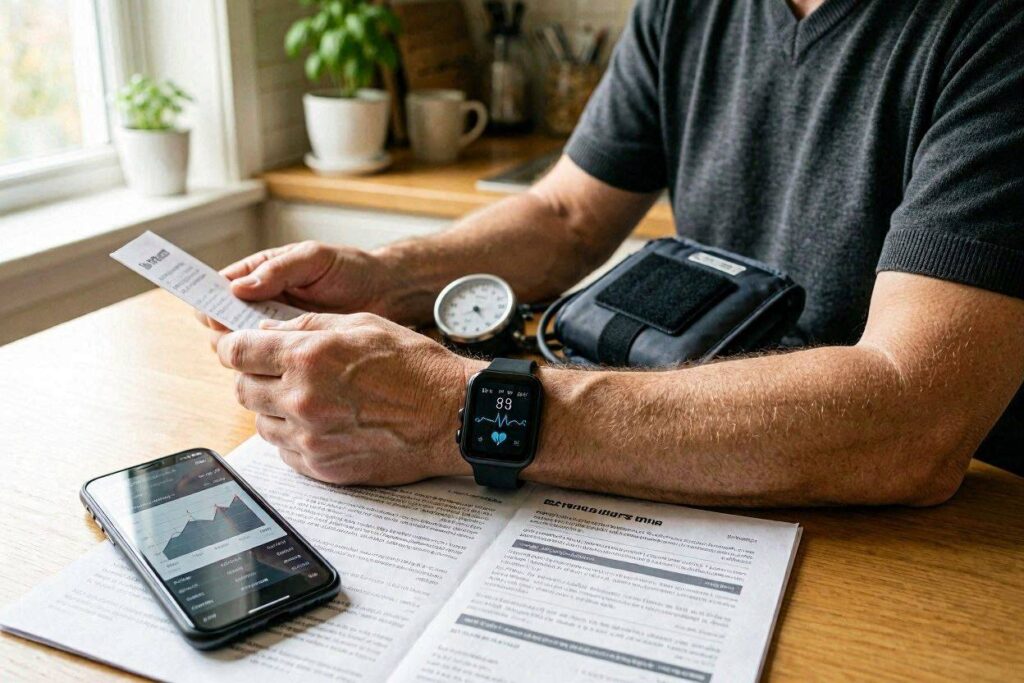
- Unverified Data Inundation: Clinicians are increasingly seeing patients arrive with pages of fluctuating smartwatch data. Because these consumer devices lack standard clinical validation, doctors cannot safely use this data to adjust prescription medication dosages.
5. Navigating the Wearable Market Today
To use these devices safely, you must understand the distinction between general consumer electronics and certified medical tech:
| Device Category | Core Mechanism | Validation Status | Primary Intent |
| Consumer Smartwatches | Pure Optical PPG / Cloud Algorithms | Generally unvalidated for absolute diagnosis; cleared for wellness. | Identifying broad lifestyle trends over time. |
| Specialized Wrist Monitors | Built-in micro-inflatable wrist bladders | Medically validated (e.g., FDA cleared or CE marked) when held at heart level. | Active, diagnostic monitoring for hypertensive tracking. |
6. Closing the Precision Gap: The Path Forward
To turn the smartwatch into a reliable health tool, the wearable tech industry is moving away from basic optical guessing.
Engineers are developing multi-wavelength sensors that combine green light with infrared wavelengths to penetrate deeper into tissue, reducing errors caused by skin tone variations. Additionally, future devices aim to pair optical sensors with bioimpedance arrays—which pass weak, imperceptible electrical currents through the wrist to measure fluid shifts—allowing the device to track arterial wall stiffness in real time.
Until these advanced hybrid sensors become standard in consumer wearables, your smartwatch should be treated as a trend tracker, not a definitive clinical tool. If your watch shows an unusual trend over several days, do not panic. Instead, verify those numbers using a validated upper-arm cuff monitor before making any decisions about your health.